
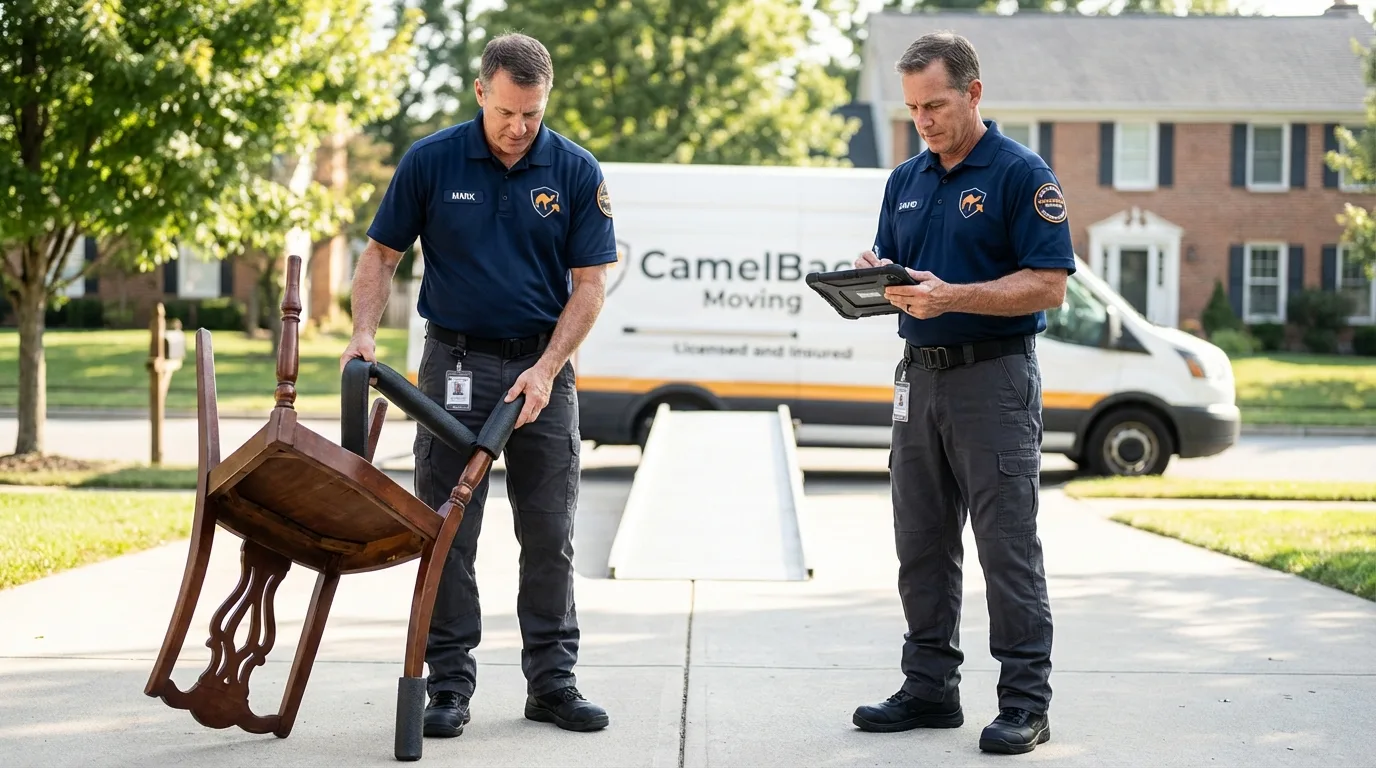
Moving Insurance & Damage Resolution in Hebron, CT
Full value protection, claims tracking, and damage documentation in Hebron, CT.
Call (833) 378-2250 for Immediate Dispatch USDOT Licensed
  24/7 Dispatch
  Damage-Free Guarantee
  Upfront Quotes
 Do moving companies cover damaged items?
Licensed residential movers must provide basic coverage under federal and state regulations, but payout methods differ significantly. Standard liability covers items by weight at sixty cents per pound regardless of value. Homeowners seeking guaranteed replacement should purchase additional full value protection.
Federal law sets the baseline. Every licensed residential carrier operating across state lines must offer basic liability at no extra charge. That coverage is called Released Value. It sounds robust until you do the math. Sixty cents per pound is the maximum payout. Break a solid oak table worth two thousand dollars, and you might receive sixty dollars if it weighs a hundred pounds. That covers the weight. Not the value.
Full Value Protection flips that structure. You pay a premium upfront. The carrier then commits to repairing, replacing, or paying cash for the item at current market rates. The math changes completely. CamelBack operates under both coverage tiers. We follow Connecticut Bureau of Public Utilities valuation rules for local routes and federal FMCSA guidelines for cross-state hauls in Hebron. Read the fine print carefully. Many budget carriers advertise full coverage in their marketing but deliver basic weight-based reimbursement in their contracts. We don't do that. Our pricing sheets list exact premium rates before you sign.
| Coverage Type | Cost to Homeowner | Payout Method | Deductible Option | FMCSA Required? |
|---|---|---|---|---|
| Released Value | $0 (included) | $0.60 per pound | None | Yes |
| Full Value Protection | 1-2% of declared value | Repair, replace, or cash | $0, $250, or $500 | No, but required for high-value |
What is the difference between released value protection and full value protection?
Released value protection is the default no-cost option that reimburses sixty cents per pound regardless of original value. Full value protection requires a premium payment calculated by shipment weight. It guarantees repair, replacement, or full cash reimbursement at current market replacement rates.
Look at real numbers for a standard Hebron move. A ten pound ceramic vase drops during transit. Released value pays out exactly six dollars. Full value protection matches the retail replacement cost of one hundred twenty dollars. The difference is obvious right there.
Larger items show the same gap. A two hundred pound sectional sofa takes a deep frame tear. Released value hands over one hundred twenty dollars. That barely covers the shipping label for a replacement. Full value covers the actual eight hundred dollar replacement cost plus labor fees. You pay a premium upfront. That premium buys certainty.
Deductible selection shifts your upfront cost too. Picking a zero dollar deductible maximizes your premium but removes out-of-pocket surprises during a claim. A two hundred or five hundred dollar deductible drops the initial charge. You cover minor dings. The carrier handles structural breaks. Connecticut requires specific valuation multipliers based on your total shipment weight. We calculate those rates transparently before loading day.
| Load Weight | Released Value Payout | Full Value Payout | Premium Surcharge | Best Use Case |
|---|---|---|---|---|
| 1,000 lbs (Studio Apt) | Up to $600 | $10,000 - $15,000 | $100-$300 | Low-value furniture |
| 4,500 lbs (3 Bed House) | Up to $2,700 | $45,000 - $65,000 | $450-$1,300 | Full household relocation |
| 8,000+ lbs (Estate) | Up to $4,800 | $100,000+ | $900-$1,800 | High-value collections |
How much does full value protection cost for a residential move?
Full value protection typically costs between one percent and two percent of your total declared shipment value. State rates vary. Premiums scale with inventory value, transport distance, and deductible selection. Higher declared values increase premiums proportionally while selecting a deductible reduces upfront cost.
Pricing scales with your declared inventory. Standard carriers charge between twelve and twenty five cents per pound for the added protection. That number fluctuates based on distance and your chosen deductible. Connecticut rates shift slightly depending on local regulatory caps and seasonal demand spikes.
Booking during peak months raises the premium. June through August sees higher claim volumes. Carriers adjust rates accordingly. Lock in your coverage quote early to freeze the rate at the base level. Waiting until moving week often adds an expedited processing fee.
Use the weight-to-value breakdown before you decide. Low-value student furniture rarely justifies a full value premium. Antique dining sets, custom leather sectionals, and imported ceramics do. The math decides your path.
| Declared Inventory Value | Premium Range (Local Hebron) | Premium Range (Long Distance) | Deductible Impact |
|---|---|---|---|
| $10,000 - $20,000 | $100 - $350 | $150 - $500 | -$50 with $250 deductible |
| $25,000 - $50,000 | $375 - $800 | $500 - $1,200 | -$125 with $500 deductible |
| $50,000+ | $900+ | $1,300+ | Custom tier pricing applies |
Calculate Exact Valuation for Hebron, CT. Speak to a Coverage Advisor at (833) 378-2250.
What items are excluded from standard moving insurance policies?
Standard policies rarely cover cash, securities, collectibles, perishable foods, live plants, hazardous materials, or improperly packed customer items. High-value jewelry, fine art, and sensitive electronics often require scheduled endorsements or third-party specialty transit policies to guarantee full replacement coverage.
FMCSA Part 374 and Connecticut statutes draw clear boundaries around what transit policies cover. Carriers will not insure anything that poses a safety hazard, spoils, or lacks a verifiable purchase record. That list covers currency, jewelry over five hundred dollars without an appraisal, fragile glassware, and live plants.
Customer packed boxes create a major coverage gap. If you pack a box yourself without professional materials or sealing, standard policies void the weight-based reimbursement for those specific items. We call this the non-payment clause. It protects the carrier from hidden breakage inside improperly sealed packages.
Schedule high-value pieces separately. Take timestamped photographs before moving day. Keep original receipts and professional appraisal documents handy. CamelBack offers custom crating for items that fall outside standard coverage limits. Standard municipal parking permits required seventy two hours before loading. Contact Hebron public works or building management for elevator reservation and loading zone clearance. often overlap with high-value loading protocols. Secure routes require additional documentation for valuable pieces.
- Cash, bearer bonds, and stock certificates
- Explosives, flammable liquids, and aerosols
- Perishable food and open chemicals
- Customer-packed boxes without professional sealing
High value items demand a paper trail. Build yours before the truck arrives.
How do I file a moving damage claim correctly?
Document all damage within nine days by taking timestamped photographs, annotating the moving bill of lading, and submitting a written claim to the carrier within one hundred twenty days. Carriers must respond within one hundred twenty days and finalize settlements within nine months.
Speed matters. You must document damage immediately. Verbal complaints mean nothing. Written submissions start the legal clock.
Step-by-Step Claim Filing Process
Inspect every item before signing the delivery paperwork. Note any dents or tears directly on the bill of lading.
Take timestamped photographs of the damage from multiple angles. Include the item tag and packaging debris.
Submit a formal written claim via email or our online portal within one hundred twenty days.
Keep copies of all receipts, repair estimates, and adjuster correspondence.
Await carrier response. Federal law grants one hundred twenty days for a reply and nine months for final settlement.
Missing the nine-day documentation window or signing a clean delivery receipt severely limits your options. Connecticut handles disputes through mediation first. Small claims court covers most residential payouts under five thousand dollars. Arbitration becomes necessary only when liability percentages conflict. We recommend keeping all communication written. It creates a verifiable chain of custody for the adjuster.

Should I purchase third-party moving insurance or carrier coverage?
Carrier coverage remains the most cost-effective option for standard household goods. Third-party transit insurance provides replacement cost without weight-based depreciation for high-value collections. Policies typically cost twenty to fifty dollars per thousand dollars of declared value and require separate premium processing.
Carrier policies handle ninety percent of household goods efficiently. They process internally. You avoid external adjuster delays. Third-party transit insurance makes sense for niche collections. Wine racks, vintage electronics, and fine art often demand specialized valuation clauses. External policies charge twenty to fifty dollars per thousand dollars of declared value. They require separate premium steps.
Carrier coverage wins on simplicity. Payouts flow through CamelBack directly. Tracking numbers sync with your moving manifest. Adjusters already know your route and inventory list. Third-party carriers add paperwork steps and independent inspections. Coverage gets broader for antiques or temperature-sensitive items. CamelBack coordinates directly with accredited transit underwriters in Hebron. We handle piano crates, gallery pieces, and vintage appliances exceeding fifteen thousand dollars in single item value. The internal team manages the handoff so you don't chase paperwork.
| Asset Type | Recommended Coverage | Typical Payout Speed | Required Documentation |
|---|---|---|---|
| Standard Furniture | Carrier FVP | 30-45 days | Photos, original receipt, claim form |
| Vintage Electronics | Third-party + Carrier | 45-60 days | Serial numbers, appraisal, condition report |
| Fine Art / Antiques | Third-party Transit | 60-90 days | Professional valuation, custom crating proof |
| High-End Audio | Third-party Specialist | 30-40 days | Original packaging, serial logs |
How does CamelBack handle damage resolution and customer claims in Connecticut?
CamelBack assigns a dedicated claims coordinator within twenty-four hours of incident notification to manage documentation, adjuster communication, and repair scheduling. We maintain both coverage tiers, process verified claims directly, and eliminate arbitration delays through transparent state-level dispute resolution protocols.
We keep the process internal. External routing creates delays. Our system moves faster. A dedicated coordinator reviews your submission immediately. Photo verification happens instantly. Weight logs and inventory manifests sync automatically. We either dispatch a local repair vendor from our Connecticut network or issue a direct check for the current market replacement cost. Standard claims target fourteen day resolution. High-value items require additional adjuster review but still bypass standard arbitration queues when documentation matches exactly.
CamelBack holds active USDOT licensing and bonded status. Our insurance carriers operate under strict state regulatory oversight. You will never face outsourced delay tactics. File claims directly. Verified claims under FVP do not require legal representation. We process them in-house. Transparency drives the workflow.
Valuation & Coverage Calculator
Released Value vs Full Value Protection. Real math.
Household declared value?
Also Serving Nearby Cities
Need a quote in Hebron?
Skip the generic estimates. Speak directly with our CT dispatchers to lock in your weight boundaries and binding date.
CONFIRM DISPATCH: (833) 378-2250